
Mineral Processing Agglomeration Binders Market to Reach USD 1,599.66 Billion by 2035 at 4.75% CAGR
Mineral Processing Agglomeration Binders Market1
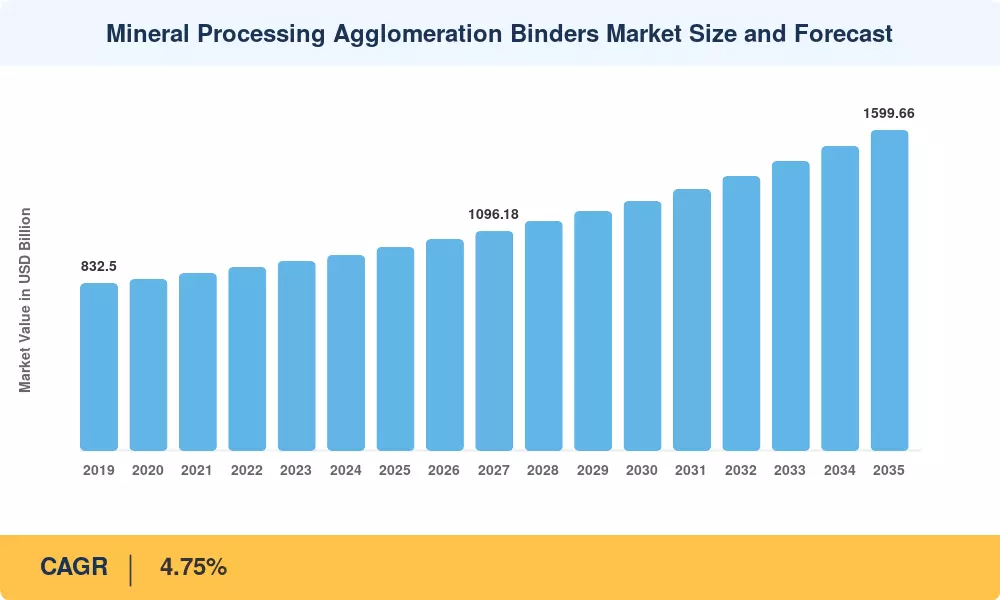
The global mineral processing agglomeration binders market was valued at USD 1,013.603 billion in 2025
The global mineral processing agglomeration binders market was valued at USD 1,013.603 billion in 2025 and is projected to reach USD 1,599.661 billion by 2035,”
NEW YORK, NY, UNITED STATES, July 29, 2026 /EINPresswire.com/ -- The global mineral processing agglomeration binders market was valued at USD 1,013.603 billion in 2025 and is projected to reach USD 1,599.661 billion by 2035, registering a compound annual growth rate (CAGR) of 4.75% during the 2026–2035 forecast period.— Arti Dhapte
Market Overview
Mineral processing agglomeration binders are specialized chemical formulations used to agglomerate fine mineral particles into larger, more manageable forms such as pellets, briquettes, or tablets for efficient handling, transportation, and further processing. These binders function by creating adhesive and cohesive bonds between mineral fines, ensuring structural integrity during subsequent handling, drying, and thermal processing stages. The global market encompasses various binder types including inorganic binders (bentonite, cement, lime), organic binders (lignin, cellulose, starch derivatives), and polymer-based binders (synthetic polymers, polyacrylamides), serving critical applications across iron ore pelletization, copper heap leaching, gold processing, lithium extraction, and briquetting operations.
Starting from an estimated USD 1,053.323 billion in 2026, the market is propelled by two structural forces: rising mining and mineral processing activities worldwide and the persistent need for improved material handling across beneficiation operations. Global capital expenditure in mining has trended upward since 2021, driven by the electrification of transport and the corresponding surge in demand for battery-grade minerals such as lithium, copper, and nickel. Government-backed mineral security initiatives across the United States, European Union, and India have further catalyzed upstream investments, generating sustained demand for high-performance agglomeration binders.
Industry trends indicate a decisive shift toward advanced polymer-based and organic binder technologies. With a market share of USD 578.14 million in 2025, the inorganic binders category leads the industry thanks to the long-standing usage of bentonite and cement-based formulations in the pelletization of iron ore. At a CAGR of 5.72%, the polymer-based binders market is becoming the fastest-growing category, indicating a structural shift toward sophisticated formulations that provide excellent green and dry pellet strength while lowering impurity introduction. Abhitech Energycon's creation of the OB-1205 organic binder, which replaces bentonite in iron ore pelletization, reduces SiO₂ and Al₂O₃ concentration, and supports low-carbon steelmaking goals, serves as an example of this shift.
Technological developments are rapidly expanding the market's capabilities. Advanced polymer-based binders are engineered to deliver superior pellet quality, higher cold compressive strength, and reduced moisture sensitivity compared to conventional bentonite. The development of organic binders from renewable feedstocks—such as lignin and cellulose—is attracting investment due to compatibility with carbon-neutral steelmaking objectives and sustainable procurement criteria. The adoption of digital monitoring and process control systems is enabling real-time optimization of binder dosage, improving efficiency and reducing waste.
📍 Get Free Sample Report for Detailed Market Insights:
https://www.marketresearchfuture.com/sample_request/68391
Market Segmentation
By Ore Type
The market is segmented by ore type into Iron Ore, Copper, Gold, Lithium, and Others. Iron ore dominates the segment with USD 560.12 million in 2025, reflecting the massive installed base of pellet plants worldwide, driven by global steel demand and pellet plant expansion. Copper is the fastest-growing ore segment at 5.92% CAGR, driven by the global push to electrify transport and energy infrastructure, which requires substantial copper mine supply additions. Gold processing binder demand is growing at 5.47% CAGR, driven by heap leach operations in Africa and Latin America. Lithium, though smaller in absolute terms at USD 66.00 million, represents a strategically important and rapidly expanding addressable market for specialty binder formulations driven by the EV battery supply chain.
By Binder Type
Binder type segmentation includes Inorganic Binders, Organic Binders, and Polymer-Based Binders. Inorganic binders remain dominant at USD 578.14 million in 2025, owing to the extensive global installed base of bentonite-consuming pellet plants and the low unit cost of conventional clay and cement binders. Polymer-based binders are the fastest-growing segment at 5.72% CAGR, reflecting a technology substitution trend where pellet producers seek to reduce gangue mineral introduction and achieve higher metallurgical pellet quality. Organic binders, growing at 4.28% CAGR, benefit from sustainability positioning and compatibility with bio-economy strategies in Europe and North America.
By Application
Application segmentation covers Pelletization, Briquetting, Leaching Process, and Others. Pelletization is the dominant application at USD 481.16 million in 2025, driven by the vast global iron ore pellet production infrastructure and the transition to direct-reduced iron (DRI) processes. Briquetting is the fastest-growing application at 5.35% CAGR, reflecting growing industry interest in agglomerating mineral fines, processing wastes, and by-products into value-added products. This trend is particularly pronounced in regions with tightening waste disposal regulations and rising demand for direct-charge furnace feed materials. Leaching Process represents USD 132.33 million, serving copper and gold heap leach pad construction.
By Region
Regional segmentation includes North America, Europe, Asia Pacific, South America, and the Middle East and Africa. Asia-Pacific is the dominant region with USD 303.49 million in 2025 and the highest CAGR of 5.25%. North America is the second-largest region at USD 345.87 million with a 4.21% CAGR. Europe accounts for USD 279.73 million. South America represents USD 54.95 million, and the Middle East & Africa accounts for USD 29.57 million.
🛒 You can buy this market report at:
https://www.marketresearchfuture.com/checkout?currency=one_user-USD&report_id=68391
Regional Analysis
Asia-Pacific
Asia-Pacific is the dominant regional market with USD 303.49 million in 2025, growing at the highest regional CAGR of 5.25%. China's pellet production capacity, which exceeds 300 million tonnes per annum, makes it the single largest binder consumption market globally. China anchors regional demand through massive pellet plant capacity and steel output. India is emerging as the primary growth engine, with government targets to reach 300 MTPA steel capacity by 2030, necessitating major expansions in pelletization capacity across Odisha, Jharkhand, and Chhattisgarh. India's National Mineral Policy and Production-Linked Incentive schemes for specialty chemicals further de-risk investments in domestic binder manufacturing. Australia contributes through its expanding lithium spodumene and iron ore processing industries.
North America
North America contributes USD 345.87 million in 2025, making it the largest regional market by revenue and the fastest-growing region overall at a 4.21% CAGR. The region's growth trajectory is anchored by the United States' Inflation Reduction Act and bipartisan support for domestic critical mineral supply chains. Major lithium extraction projects in Nevada, Arkansas, and North Carolina are introducing agglomeration process steps that require specialized organic and polymer-based binders. Canada's established base metals mining industry in the Canadian Shield continues to generate steady demand for conventional and next-generation binder chemistries, driven by nickel and copper belt expansion in Ontario and Québec. Mexico's modernizing silver and copper processing sector adds incremental volume.
Europe
Europe accounts for USD 279.73 million in 2025 and is forecast to grow at a 5.02% CAGR through 2035. The region's growth is driven by the European Green Deal's emphasis on decarbonized steel production and circular economy principles. The transition from blast furnace to direct-reduced iron (DRI) processes increases demand for high-quality iron ore pellets, which in turn requires binders that deliver consistent metallurgical performance and minimal impurity introduction. Germany leads binder consumption, supported by green steel transition and DRI/pellet demand. Sweden serves as an innovation hub through the HYBRID project and fossil-free steel initiatives. Finland's growing market is driven by battery minerals processing at Terrafame operations. The EU's Carbon Border Adjustment Mechanism is expected to favor advanced binders that reduce embodied carbon in steel products.
South America
South America contributes USD 54.95 million in 2025, growing at a 4.65% CAGR. Brazil is the regional anchor, housing some of the world's largest iron ore pellet plants operated by Vale and CSN Mining. Chile's copper sector generates sustained demand for heap leach binders and flotation-related agglomeration aids. Argentina's rapidly developing lithium extraction industry in the Lithium Triangle (Jujuy, Salta, Catamarca provinces) is introducing new binder requirements for lithium carbonate processing circuits, representing a growing opportunity for specialty binder formulations.
Middle East & Africa
The Middle East & Africa region accounts for USD 29.57 million in 2025, with a 3.15% CAGR through 2035. While the smallest regional market, growth is supported by gold mining expansion in West Africa, copper-cobalt processing in the Democratic Republic of Congo, and phosphate agglomeration in Morocco and Tunisia. South Africa is the largest African market, driven by platinum group metals and iron ore processing. Saudi Arabia's Vision 2030 program is investing in domestic mineral extraction and processing, creating new demand pockets for agglomeration binders.
Competitive Landscape / Key Players
The mineral processing agglomeration binders market exhibits a moderately concentrated structure, with the top tier of players capturing approximately 48.3% of global revenue. Key companies operating in this market include Solenis (~12% share), SNF (~10%), Clariant AG (~9%), Nouryon (~8%), Borregaard AS (~5%), Abhitech Energycon (~5%), Jianjie Group (~5%), LigninCorp (~4%), Maxton Industrial Co. (~4%), and Rantec Corporation (~3%).
Strategic developments in the market include significant acquisitions and product innovations. In July 2024, Solenis signed a definitive agreement to acquire BASF's mining flocculants business, encompassing the Magnafloc®, Rheomax®, and Alclar® product families, significantly broadening Solenis's mineral processing portfolio beyond its existing binder offerings. In March 2024, Abhitech Energycon developed and commercialized the OB-1205 organic binder specifically designed for iron ore pelletization as a direct replacement for bentonite, achieving pellet quality metrics that match or exceed bentonite-based benchmarks while eliminating SiO₂ and Al₂O₃ impurities.
Competitive differentiation increasingly hinges on technical performance, sustainability credentials, and regional service capabilities. The acquisition of BASF's mining flocculants portfolio by Solenis reflects a trend toward platform-level integration, where top chemical companies want to provide full mineral processing chemistry suites instead of individual binder products. As larger businesses look for access to bio-based binder technologies, mid-tier companies may benefit from M&A interest, while new competitors from the specialty polymers industry may affect pricing dynamics in the polymer-based binder market.
Latest Industry News & Developments
Recent industry developments highlight the ongoing transformation of the mineral processing agglomeration binders market toward advanced chemistries and portfolio consolidation. In July 2024, Solenis signed a definitive agreement to acquire BASF's mining flocculants business, encompassing the Magnafloc®, Rheomax®, and Alclar® product families. This transaction significantly broadens Solenis's mineral processing portfolio beyond its existing binder offerings, creating a more comprehensive solution set for mining customers. The acquisition enhances Solenis's ability to offer integrated flocculant-binder packages, improves operational efficiency through scale, and strengthens its sustainability credentials by consolidating expertise in water treatment and mineral recovery under a single platform.
In March 2024, Abhitech Energycon developed and commercialized the OB-1205 organic binder specifically designed for iron ore pelletization as a direct replacement for bentonite. The product forms strong adhesive and cohesive bonds between iron ore fines, achieving pellet quality metrics that match or exceed bentonite-based benchmarks while eliminating the introduction of SiO₂ and Al₂O₃ impurities. This results in higher iron content in finished pellets, reduced fuel consumption during induration, and lower overall production costs. The OB-1205 product is particularly significant in the context of low-carbon steelmaking, where pellet purity directly impacts DRI process efficiency and downstream carbon emissions.
In April 2024, FLS inaugurated a new mill liner manufacturing facility in Casablanca, Chile, powered entirely by renewable energy sources with full water reuse systems. The LEED-certified plant achieves up to 56% reduction in manufacturing emissions compared to conventional facilities, serving as a demonstration project for sustainable mining infrastructure under FLS's MissionZero strategy. While primarily a mill liner facility, the plant's establishment reinforces the broader trend of mining supply chain investments in Latin America and the commitment of major OEMs to carbon-neutral operations.
Market Challenges & Opportunities
Key restraints facing the mineral processing agglomeration binders market include the high cost of advanced binders, with polymer-based and organic binders still costing two to five times as much per tonne of pellet as traditional bentonite or cement-based alternatives. For mining operations in cost-sensitive locations, the total cost of ownership calculation may not always favor advanced binders, especially for lower-grade ore deposits where metallurgical payback is limited. The technical sales cycle for innovative binder chemistries may require an additional 12 to 24 months for pilot-scale pelletization experiments and customer validation procedures. This cost and adoption-speed barrier explains why inorganic binders continue to dominate by absolute value despite slower growth rates and moderates the overall market CAGR, particularly in the early forecast period.
Emerging opportunities in the market are substantial and diverse. Rapid industrialization and mining investments in India, Southeast Asia, and sub-Saharan Africa create a significant growth opportunity for agglomeration binder suppliers. India alone plans to nearly double its steel production capacity to 300 million tonnes per annum by 2030, requiring a proportional increase in iron ore pellet production and associated binder consumption. The global push to secure diversified supply chains for copper, lithium, cobalt, and rare earths is catalyzing greenfield mining projects in jurisdictions previously considered marginal, with each new heap leach pad, pellet plant, or briquetting facility representing an incremental addressable market.
Future potential lies in the continued development of polymer-based and organic binder technologies, with polymer-based binders growing at 5.72% CAGR as pellet manufacturers work to maximize cold compressive strength, minimize silica contamination caused by bentonite, and satisfy more stringent environmental regulations. Organic binders made from cellulose and lignin are drawing investment due to compatibility with carbon-neutral steelmaking objectives and sustainable feedstock base. The adoption of digital monitoring and process control systems enabling real-time optimization of binder dosage will improve efficiency and reduce waste. Companies that establish early positions in emerging mining regions through joint ventures, technical service agreements, or local manufacturing are likely to capture a disproportionate share of incremental demand.
To explore more market insights, visit us at:
https://www.marketresearchfuture.com/reports/mineral-processing-agglomeration-binders-market-68391
Final Market Summary
The mineral processing agglomeration binders market is positioned for steady growth through 2035, driven by rising mining and mineral processing activities worldwide, the persistent need for improved material handling, and the accelerating transition to advanced polymer-based and organic binder technologies. The projected valuation of USD 1,599.66 billion reflects sustained demand across iron ore pelletization, copper heap leaching, gold processing, and lithium extraction, with the market transitioning from conventional inorganic formulations to high-performance, low-impurity, and sustainable binder solutions.
The medium-term growth outlook remains positive, with the market registering a CAGR of 4.75% during the forecast period. Asia-Pacific will continue to lead market expansion through China's massive pellet plant capacity and India's steel capacity growth, while North America emerges as the fastest-growing region driven by critical minerals policy and lithium project buildout. The ongoing development of polymer-based binders, organic formulations, and digital optimization platforms will continue to expand market possibilities and applications.
Long-term industry potential extends beyond the current forecast horizon. The energy revolution and urbanization in emerging nations will sustain structural demand for minerals, while government-sponsored critical minerals programs will drive investment in new processing capacity. Sustainability and regulatory pressures, including the EU's Carbon Border Adjustment Mechanism and tightening emissions standards, will accelerate adoption of binders that reduce dust
More Related Reports from MRFR Library:
Industrial Wastewater Treatment Service Market: https://www.marketresearchfuture.com/reports/industrial-wastewater-treatment-service-market-28213
Electrochemical Transformation Market: https://www.marketresearchfuture.com/reports/electrochemical-transformation-market-28419
Laser Processing Equipment Market: https://www.marketresearchfuture.com/reports/laser-processing-equipment-market-28422
Liquid Cooling System Market: https://www.marketresearchfuture.com/reports/liquid-cooling-system-market-28429
Equipment As A Service Market: https://www.marketresearchfuture.com/reports/equipment-as-a-service-market-28460
Residential Cold Climate Heat Pump Market: https://www.marketresearchfuture.com/reports/residential-cold-climate-heat-pump-market-28490
Refrigerant Compressor Market: https://www.marketresearchfuture.com/reports/refrigerant-compressor-market-28526
Stone Processing Machine Market: https://www.marketresearchfuture.com/reports/stone-processing-machine-market-29189
Beach Cleaning Equipment Market: https://www.marketresearchfuture.com/reports/beach-cleaning-equipment-market-29294
Crane And Hoist Market: https://www.marketresearchfuture.com/reports/crane-and-hoist-market-29559
Larry Wilson
WantStats Research And Media Pvt. Ltd.
+1 855-661-4441
email us here
Legal Disclaimer:
EIN Presswire provides this news content "as is" without warranty of any kind. We do not accept any responsibility or liability for the accuracy, content, images, videos, licenses, completeness, legality, or reliability of the information contained in this article. If you have any complaints or copyright issues related to this article, kindly contact the author above.
